What is Business Analytics ?
17 Jan 2026
How do you think companies predict what customers want, optimise their operations, or stay ahead of competitors in this fast-paced economy?
With India being one of the fastest-growing markets, understanding business analytics has never been more crucial.
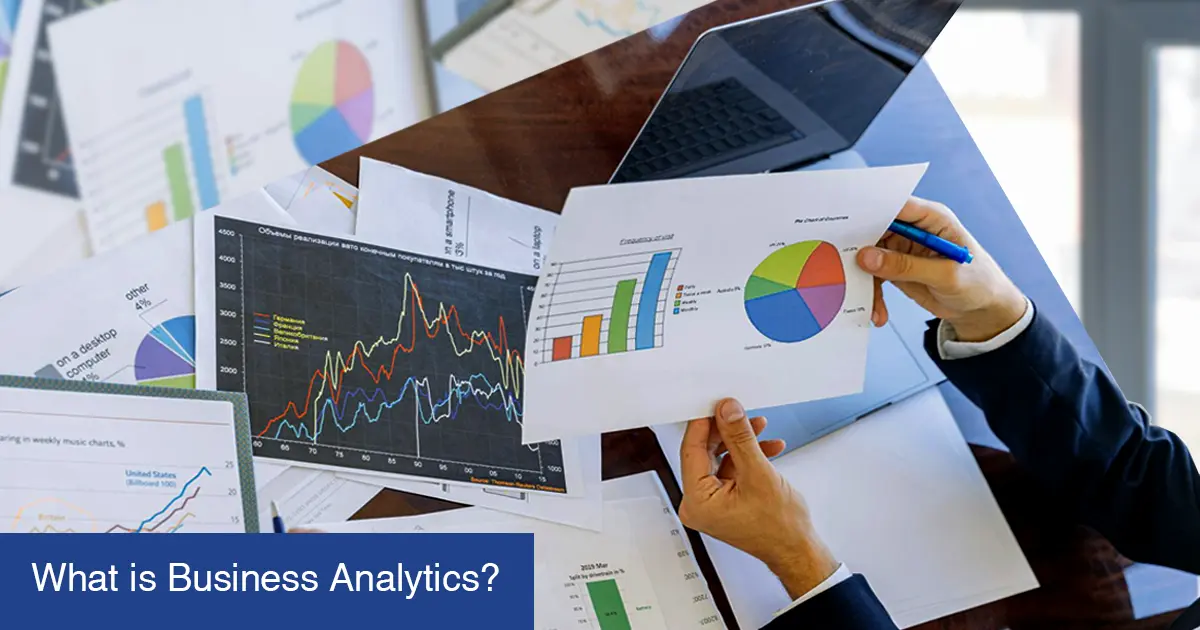
Business analytics is the process of assessing historical and real-time data to make strategic business decisions that drive organisational growth and development.
From healthcare to finance, marketing to retail, business analytics helps companies optimise operations, improve customer engagement, and gain a competitive edge.
In this blog, we’ll learn what business analytics is in depth.
What is Business Analytics?
Business data is collected by different departments of a company including sales, marketing, human resources, and finance among others.
This data is used by organisations to make decisions and determine what will most likely benefit their objectives.
Data analysis, data mining, and predictive analytics are techniques that businesses apply to make sound business decisions.
With these methodologies, companies can gain valuable insights to enhance their strategic decision-making and plan more effectively for the future.
Types of Business Analytics
Here are four types of Business Analytics that organisations can implement, depending on their business objectives and available technical infrastructure. These are as follows:
Descriptive Analytics
Primarily used in business intelligence, descriptive analytics focuses on understanding what has happened in the past.
Predictive Analytics
This type uses data analysis, predictive models, and forecasting to answer the question: “What is likely to happen in the future?”
Prescriptive Analytics
Building on predictive analytics, prescriptive analytics recommends the best course of action to achieve optimal results.
Diagnostic Analytics
Leveraging advanced AI and machine learning, Diagnostic Analytics learns from big data and automatically applies actions that yield the best outcomes.
How to Make Business Decisions Based on Analytics?
Data-driven decision-making helps organisations to achieve the business objectives and also to develop business strategies and decisions for the future. Here are some ways a business can make decisions based on analytics:
Define Clear Objectives
Effective data-driven decisions start with clear business objectives. These objectives should be specific, measurable, and aligned with broader organisational goals.
Identify and Collect Data
Once the goals are set, organisations should know what data are valuable. This might involve internal databases, revenue records, website analytics and external sources, like third party platforms.
Organise Data
Data has to be cleansed, organised, and arranged to be useful for its analysis. This includes dealing with missing values, eliminating inconsistency as well as classifying data types.
Analyse Data
Excel, Python, Tableau, and Power BI are some of the tools that analysts use to derive actionable insights. They can analyse data, perform data analysis or even use machine learning techniques based on the nature of the problem.
Derive Conclusions
Insights are interpreted in the context of business objectives to derive meaningful conclusions. This step ensures that findings translate into actionable recommendations and guide decision-making.
Implement Decisions and Monitor
Decisions based on data insights should be implemented with a clear plan for monitoring outcomes. Continuous feedback mechanisms help track progress, adapt strategies as needed, and improve future decision-making.
Overview of Business Analytics Courses
There are several Business Analytics courses available in the market if you wish to pursue a career in this field.
These courses cover core business topics such as Principles of Management, Business Economics, and Principles of Marketing, as well as subject-specific topics such as data visualisation, statistical analysis, and predictive modelling.
Let us look at the types of Business Analytics courses that you can pursue:
| Course Name | Level of Education | Duration | Topics Covered |
| Bachelor of Business Administration (BBA) in Business Analytics and Intelligence | Undergraduate | 3 years |
|
| BBA Business Analytics Accredited by the IoA, UK | Undergraduate | 3 years |
|
| Bachelor of Commerce (BCom) in Business Analytics | Undergraduate | Usually 3 years (Courses that offer Honours with Research paper can span 4 years) |
|
| Master of Business Administration (MBA) in Business Analytics | Postgraduate | 2 years |
|
| MBA in Finance and Business Analytics | Postgraduate | 2 years |
|
| MBA in Marketing and Business Analytics | Postgraduate | 2 years |
|
Career as a Business Analyst in India
The demand for Business Analysts in India is surging as organisations increasingly prioritise data-driven strategies. The most common areas to see this hiring trend are IT, finance, healthcare and e-commerce.
According to the Naukri.com statistics, the number of Business Analyst jobs has increased by 21 per cent over the past decade.
Most of the professionals join the job as the Junior Analysts and then proceed to take up senior-level roles. Let us look at the career progression:
- Junior Business Analyst: Entry-level job role specialising in data collection and reporting
- Senior Business Analyst: Senior executives who deal with identification of business problems and corrective action
- Lead Business Analyst: Mid-level role that is familiar with business problems, explores possible solutions and manages teams to implement strategic decisions.
- Manager: Strategy theorists who help the team achieve organisational objectives
To succeed in this field, you must possess technical skills and business acumen. Let us look at some of the best skills you should have to build a successful career in this field:
Data Analysis
Good knowledge of statistical analysis (regression, hypothesis testing) and software, such as Excel, Python, R, SAS, or SPSS.
Visualisation & Databases
Knowledge of how to design dashboards and perform data modelling and mining with the help of Tableau, Power BI, and SQL.
Industry Knowledge
Far insight into market trends and best practices.
Web & CRM Tools
Knowledge of a business-specific platform such as Google Analytics or Salesforce on business performance assessment.
Commercial Awareness
To stay up-to-date via networking, industry forums and publications to align data insights with organisational objectives.
Project Management Knowledge
Knowledge of Agile and Waterfall frameworks to ensure projects stay on track
Coordination Tools
Proficiency in project coordination tools such as Trello, Asana, or Microsoft Project to manage timelines, resources, budgets, and stakeholder communication.
Summing Up
Companies no longer rely on intuition; they use data to understand their past and predict future outcomes, helping them stay competitive in the modern world.?
With India emerging as a global tech hub, if you can interpret data to make strategic business decisions, you can become the next generation of industry leaders.
By building expertise in Business Analytics, you can align your analytical skills to solve real-world business problems.
Programmes at JAIN (Deemed-to-be-University) offer a structured pathway to develop the technical, analytical, and domain knowledge required for this evolving field.
FAQs
Q1. What are the 5 stages of business analysis?
A1: The 5 stages of business analysis are as follows:
- Strategic Alignment: Synchronise high-level strategy with actionable tactics and a clear value proposition.
- Feasibility & Expectations: Define a realistic scope of change while establishing and managing business expectations.
- Narrative Matching: Craft a story that bridges the gap between organisational needs and the specific requirements of the stakeholders.
- Implementation: Execute the actual transition across IT systems, business processes, and company culture.
- Benefit Tracking: Continuously monitor and evaluate results over a long-term period (1–5 years) to ensure the change sticks and to maintain stakeholder trust.
Q2. What are the 4 types of Business Analytics?
A2: The four types of business analytics are:
- Descriptive
- Diagnostic
- Predictive
- Prescriptive
Q3. What are the 4 pillars of Analytics?
A3: The four pillars of analytics are Descriptive (What happened?), Diagnostic (Why did it happen?), Predictive (What might happen?), and Prescriptive (What should we do?).
Q4. Which type of Business Analytics is best?
A4: There is no ‘single’ best type of Business Analytics. The "best" one for a company depends entirely on what question they are trying to answer.
However, Prescriptive Analytics is currently the "best" in terms of market demand. It involves AI and complex optimisation, which makes it a high-value skill for senior Business Analysts.
Recent Blogs
06 Jul 2026
06 Jul 2026
29 Jun 2026